
If you had told me five years ago that I’d travel across multiple countries without ever opening my phone’s SIM tray, I probably would’ve laughed.
Yet here we are.
Despite eSIMs becoming increasingly common, many travelers still hesitate. We hear things like “eSIMs aren’t reliable,” “they’re slower than physical SIMs,” or “they only work in a few countries.” These eSIM myths spread fast specially among travelers who can’t afford to lose connectivity abroad.
At Roam Communication, we’ve helped thousands of travelers stay connected globally. And honestly? Most of the fear around eSIMs comes from outdated information or simple misunderstandings.
So let’s clear the air.
This guide breaks down the most common eSIM myths explained clearly, compares eSIM vs physical SIM truthfully, and helps you decide what actually works best for travel today.
What Is an eSIM?
An eSIM (embedded SIM) is a digital SIM built directly into your device. Instead of inserting a plastic card, you activate a mobile plan by scanning a QR code or downloading a profile.
Think of it as software replacing hardware, just like streaming replaced DVDs.Most modern smartphones, tablets, and even laptops now support eSIM technology.
Why So Many eSIM Misconceptions Exist
Before diving into specific myths, it’s important to understand why confusion exists:
- eSIM adoption happened quietly, without big consumer education
- Early versions had limited coverage
- Many blogs still publish outdated information
- Travelers often confuse eSIM with Wi-Fi-only apps
The result? Persistent eSIM misconceptions that no longer reflect reality.
Let’s break them downone by one.

Common eSIM Myths Explained (And the Real Truth)
Myth 1: “eSIM Is Not Reliable for Travel”
This is the #1 concern we hear.
Truth:
Yes eSIM is reliable for travel, often more reliable than physical SIMs.
Modern eSIM providers (like Roam Communication) partner with tier-1 global carriers, giving access to multiple networks in each country. If one network weakens, your phone can switch automatically.
Real-world insight:
On a recent multi-country trip through Europe and Southeast Asia, one of our team members used only an eSIM. No airport kiosks, SIM swaps, downtime. Connectivity remained stable across borders.
Reliability today depends on:
- Network partnerships
- Coverage depth
- Provider quality (this part matters most)
Myth 2: “eSIM Is Slower Than Physical SIM”
Another common belief and another myth.
Truth:
Speed depends on the network, not whether the SIM is physical or embedded.
An eSIM uses the same LTE and 5G networks as physical SIMs. In many cases, travelers experience better speeds because eSIM plans often connect directly to premium networks. If you’ve ever used a cheap local SIM with throttled speeds, you already know physical SIMs aren’t automatically faster.
Myth 3: “eSIM Only Works in a Few Countries”
This myth made sense years ago but not anymore.
Truth:
Most major eSIM providers now support 100+ countries.
At Roam Communication, our eSIM plans are designed for:
- Single-country travel
- Regional travel
- Global multi-country trips
For international travelers eSIMs remove the headache of finding a new SIM in every destination.
Myth 4: “Setting Up an eSIM Is Complicated”
If you can scan a QR code, you can use an eSIM.
Truth:
eSIM setup usually takes under 2 minutes.
Typical steps:
- Purchase an eSIM plan
- Scan the QR code
- Enable the eSIM in settings
- Start using data
Most users tell us the only hard part is realizing how easy it actually is.
Myth 5: “eSIM Is Not Secure”
This myth often comes from misunderstanding how SIMs work.
Truth:
eSIMs are more secure than physical SIMs.
Why?
- They can’t be stolen or swapped
- No risk of SIM cloning through physical access
- Profiles can be remotely disabled if needed
For travelers worried about theft or loss, eSIMs offer peace of mind.
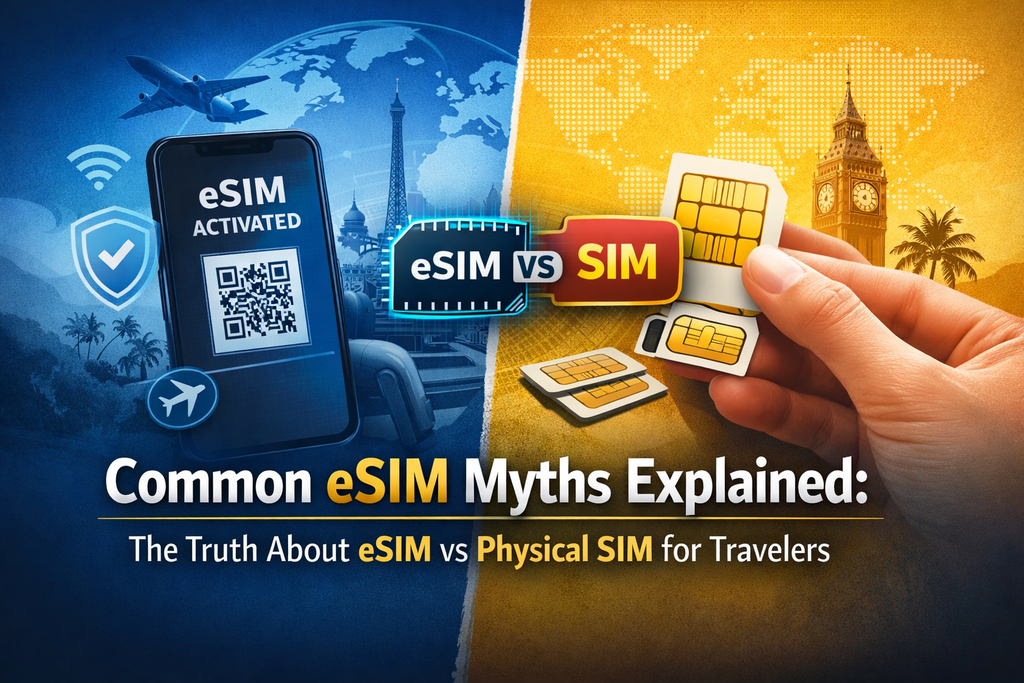
eSIM vs Physical SIM: The Truth Travelers Need
Here’s an honest comparisonno hype.
| Feature | eSIM | Physical SIM |
| Setup | Instant, digital | Requires store or delivery |
| Travel convenience | Excellent | Inconvenient |
| Risk of loss | None | High |
| Multi-country use | Seamless | Requires swapping |
| Speed & performance | Same networks | Same networks |
| Security | High | Medium |
| Environmental impact | Eco-friendly | Plastic waste |
eSIM Advantages and Disadvantages
Benefits of eSIM for Travelers
- Instant activation anywhere
- No physical SIM swapping
- Ideal for multi-country trips
- Keep your home SIM active
- Safer if your phone is lost
Disadvantages to Consider
- Requires an eSIM-compatible device
- Some older phones are unsupported
- Needs internet for initial activation
These are minor trade-offs for most modern travellers, but transparency matters.
Is eSIM Reliable for Travel? (Short Answer: Yes)
Let’s answer this clearly.
Yes, eSIM is reliable for travel when you choose a trusted provider.
Reliability depends on:
- Network partnerships
- Coverage depth
- Fair usage policies
- Customer support
eSIM FAQ for Travelers
Yes. Most phones allow dual SIM functionality.
Yes, on most devices and plans.
Absolutelye specially for frequent international travel.
Yes. Multiple eSIM profiles can be stored on one device.
No noticeable difference compared to physical SIMs.
Practical Tips Before Using an eSIM Abroad
- Install your eSIM before traveling
- Keep your QR code backed up
- Disable data roaming on your physical SIM
- Choose plans with multi-network support
- Buy from providers with real customer support
Why We Built Roam Communication for Travelers Like You
At Roam Communication, we didn’t create eSIM plans because it was trendy.
We built them because:
- Travelers deserve simplicity
- Connectivity shouldn’t be stressful
- Border crossings shouldn’t mean data loss
Every plan we offer is tested, optimized, and built with real travel scenarios in mind.
Final Thoughts: The Real Truth About eSIM Myths
Most eSIM myths come from fear of change not facts.
The truth is simple:
- eSIMs are reliable
- They’re fast
- They’re secure
- And they’re built for modern travel
Once you use one, it’s hard to go back.