

I still remember the first time my mobile data failed me abroad. I was in a small cafe in Portugal, deadline looming, Wi-Fi down, and my local SIM suddenly “no service.” That moment taught me a hard lesson: connectivity isn’t a luxury for a digital nomad’s survival. Fast forward a few years, dozens of countries later, and I rarely travel without a digital nomad eSIM ready to go. No SIM card hunting, no language barriers, no panic. Just reliable data wherever I land.
This guide is written from real long-term travel experience, not theory. On behalf of Roam Communication, I’ll walk you through the smartest eSIM strategies for remote workers, freelancers, and location-independent professionals so you stay connected, productive, and stress-free.
Why eSIMs Have Become Essential for Digital Nomads
Traditional SIM cards weren’t designed for people who cross borders every month. Digital nomads need flexibility, scalability, and reliability, and that’s exactly where eSIMs shine.
What is an eSIM?
An eSIM is a digital SIM built into your phone. Instead of inserting a plastic card, you scan a QR code and instantly activate a mobile data plan, often before you even land.
Why Digital Nomads Prefer eSIMs
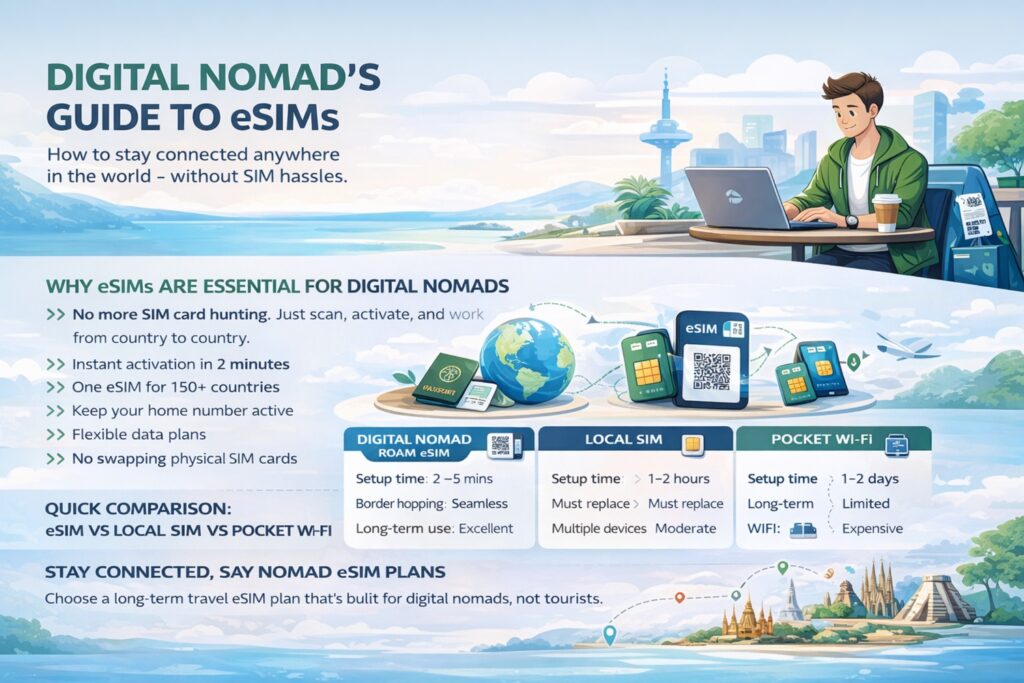
- No physical SIM swapping
- Instant activation in multiple countries
- Keep your home number active
- Flexible plans for short or long stays
- One phone, many networks
For anyone working remotely across borders, eSIM for long-term travel is no longer optional; it’s foundational.
Digital Nomad eSIM vs Local SIM vs Pocket Wi-Fi
Before choosing a strategy, let’s clear up a common question.
Quick Comparison
| Feature | Digital Nomad from Roam eSIM | Local SIM | Pocket Wi-Fi |
| Setup time | 2–5 minutes | 1–2 hours | 1–2 days |
| Border hopping | Seamless | Must replace | Limited |
| Long-term use | Excellent | Moderate | Expensive |
| Multiple devices | Phone-based | Phone-based | Yes |
| Reliability | High | Varies | Medium |
| Ideal for | Remote workers | Single-country stays | Groups |
Verdict: For serious remote work, global eSIM for nomads offers the best balance of flexibility and cost.
Best eSIM Digital Nomads: What Actually Matters
Most articles list providers. Few explain how to choose esim. Here’s what truly impacts your experience.
1. Coverage Across Regions
If you’re moving between continents, avoid country-only plans. Look for:
- Europe + Asia bundles
- Americas regional coverage
- True global eSIMs (190+ countries)
2. Data Type: Fixed vs Unlimited
- Fixed data: Cheaper, predictable
- Unlimited data: Peace of mind
For long-term travel eSIM plans, predictable data often beats “unlimited” marketing.
3. Network Priority
Premium eSIMs connect to Tier-1 local carriers, not secondary networks. This makes a massive difference for:
- Video calls
- Cloud uploads
- Live collaboration tools
4. Hotspot & Tethering
Many remote workers forget this:
- Can you share data with your laptop?
- Is hotspot usage capped?
Always confirm this before buying.
Best Data Strategies for Long-Term Travel
After years of trial and error, here’s the setup that works best for most digital nomads.
Strategy #1: One Global eSIM + Backup
My personal favourite:
- Primary: Global eSIM for nomads
- Backup: Secondary eSIM or local SIM
This combo saved me during outages in Mexico and Indonesia.
Strategy #2: Regional eSIMs for Slow Travel
If you stay 2–3 months per region:
- One Europe eSIM
- One Asia eSIM
- One Americas eSIM
This often reduces cost without sacrificing speed.
Strategy #3: Unlimited eSIM for Work Weeks
For heavy work periods (launches, deadlines):
- Use unlimited eSIM for remote workers
- Downgrade during travel weeks
Long-Term Travel eSIM Plans: What to Look For
Not all plans are created equal. Here’s a quick checklist.
Must-Have Features
- Validity: 30–180 days
- Easy top-ups
- Transparent fair-use policy
- Multi-country support
- 5G where available
Red Flags
- No refund policy
- No customer support
- Country list hidden
- Speed throttling without notice
Case Study: How I Stayed Connected Across 7 Countries
Last year, I worked remotely across: Spain → Turkey → Thailand → Vietnam → Japan → Mexico → Colombia
Using a global eSIM, I:
- Never visited a SIM shop
- Never missed a meeting
- Activated plans from airport lounges
- Kept my WhatsApp number active
Total setup time for the entire year: under 30 minutes.
That’s the power of a well-chosen international data plan for nomads.

People Also Ask
Yes. It’s one of the most reliable and flexible connectivity solutions for long-term travelers and remote workers.
Absolutely. Most modern phones support dual SIM (eSIM + physical).
Not if chosen correctly. Long-term eSIM plans often cost less than repeated local SIM purchases.
Not if chosen correctly. Long-term eSIM plans often cost less than repeated local SIM purchases.
Coverage is broad but not universal. Always check country lists before buying.
eSIM for Remote Workers: Device Compatibility Checklist
Before purchasing:
- iPhone XS or newer
- Google Pixel 3 or newer
- Samsung S20 and above
- iPad (cellular models)
Tip: Carrier-unlocked devices work best.
Final Thoughts: Connectivity Is Freedom
Being a digital nomad isn’t about beaches and laptopsit’s about reliable systems that let you live and work on your terms. A thoughtfully chosen digital nomad eSIM removes friction, reduces stress, and gives you back time and focus.
At Roam Communication, we believe connectivity should support your journeynot complicate it.
Ready to Travel Smarter?
Choose an eSIM plan designed for real long-term travelers, not tourists. Stay connected. Stay productive. Roam eSIM freely. If you’d like help choosing the right eSIM strategy for your travel style, start with a plan built for nomads not borders.